Network Traffic vs Direct Traffic: Traffic Quality Depends on Management, Not the Source
Vladyslav Donchenko
|18 Dec, 2025
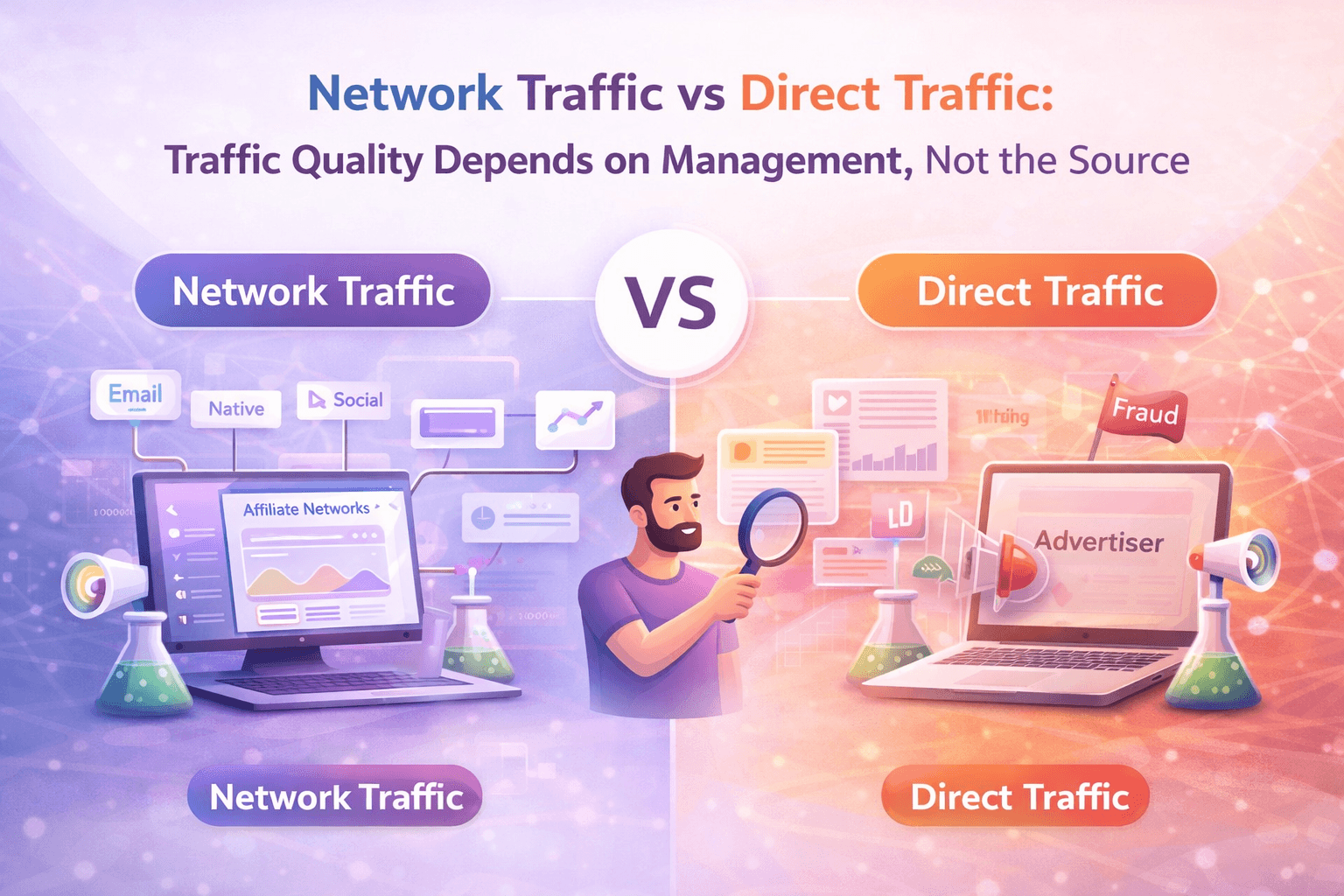
Introduction: Network Traffic vs Direct Traffic in Affiliate Marketing
In affiliate marketing, advertisers often compare network traffic vs direct traffic, assuming that direct traffic is always cleaner and more reliable.
In practice, traffic quality is not determined by whether it comes from a network or a direct publisher.
It depends on how traffic is sourced, monitored, and optimized.
This article explains why network traffic is not inherently bad, why direct traffic is not automatically good, and what truly defines high-quality affiliate traffic.
Is Network Traffic Worse Than Direct Traffic?
One of the most common myths in affiliate marketing is that network traffic equals lower quality.
This perception usually comes from experiences with:
- poorly managed affiliate networks
- lack of transparency
- volume-driven scaling without quality control
However, these issues are not caused by the network model itself — they are the result of weak traffic management.
A properly managed affiliate network can deliver traffic that performs as well as, or better than, direct traffic.
Why Direct Traffic Is Not Always High Quality
Direct partnerships are often perceived as more transparent and safer.
But direct traffic can also suffer from:
- limited scalability
- single-source dependency
- slow testing cycles
- lack of optimization once volume increases
Without proper monitoring, direct traffic can decline in quality just as quickly as unmanaged network traffic.
Direct traffic still requires:
- compliance checks
- performance monitoring
- gradual scaling
Direct ≠ controlled by default.
What Defines Traffic Quality in Affiliate Marketing
Whether traffic comes from a network or directly from a publisher, quality depends on the same factors:
1. Traffic Transparency
Clear understanding of:
- traffic sources
- formats (email, social, native, search)
- user flow and funnel structure
2. Traffic Quality Control
Ongoing monitoring of:
- approval and rejection rates
- duplication
- fraud signals
- conversion behavior
3. Compliance Management
Strict adherence to:
- brand guidelines
- messaging rules
- data protection standards
4. Controlled Scaling
Gradual volume increases based on performance data, not assumptions.
When these elements are in place, both network and direct traffic can scale successfully.
When Network Traffic Becomes an Advantage
A strong affiliate network adds value through:
- pre-vetting of publishers
- centralized traffic quality control
- faster testing across multiple sources
- redistribution of volume if one source underperforms
Instead of managing dozens of individual partners, advertisers work with one accountable operator.
This makes network traffic especially effective for:
- fast scaling
- geo expansion
- testing new traffic formats
The Risks of Relying Only on Direct Traffic
Advertisers who rely exclusively on direct traffic often face:
- slower growth
- operational bottlenecks
- higher dependency on single partners
Direct traffic works best when advertisers have strong internal resources to manage, analyze, and optimize performance continuously.
Affiliate Network Traffic vs Direct Traffic: The Real Difference
The real difference is not the source — it’s the level of management.
High-performing partners focus on:
- traffic quality, not just volume
- long-term performance metrics
- active optimization before scaling
In this model, a mature affiliate network acts as a performance manager, not just a traffic reseller.
Conclusion: Choose Management Over Labels
When comparing network traffic vs direct traffic, the source alone should never be the deciding factor.
Traffic quality is created by:
- people
- processes
- accountability
Advertisers who scale sustainably choose partners who actively manage performance, regardless of whether traffic is delivered directly or through a network.