Affiliate marketing
LTV‑oriented payouts in affiliate: how to connect CRM and tracker, measure and optimize
Vladyslav Donchenko
|05 Oct, 2026
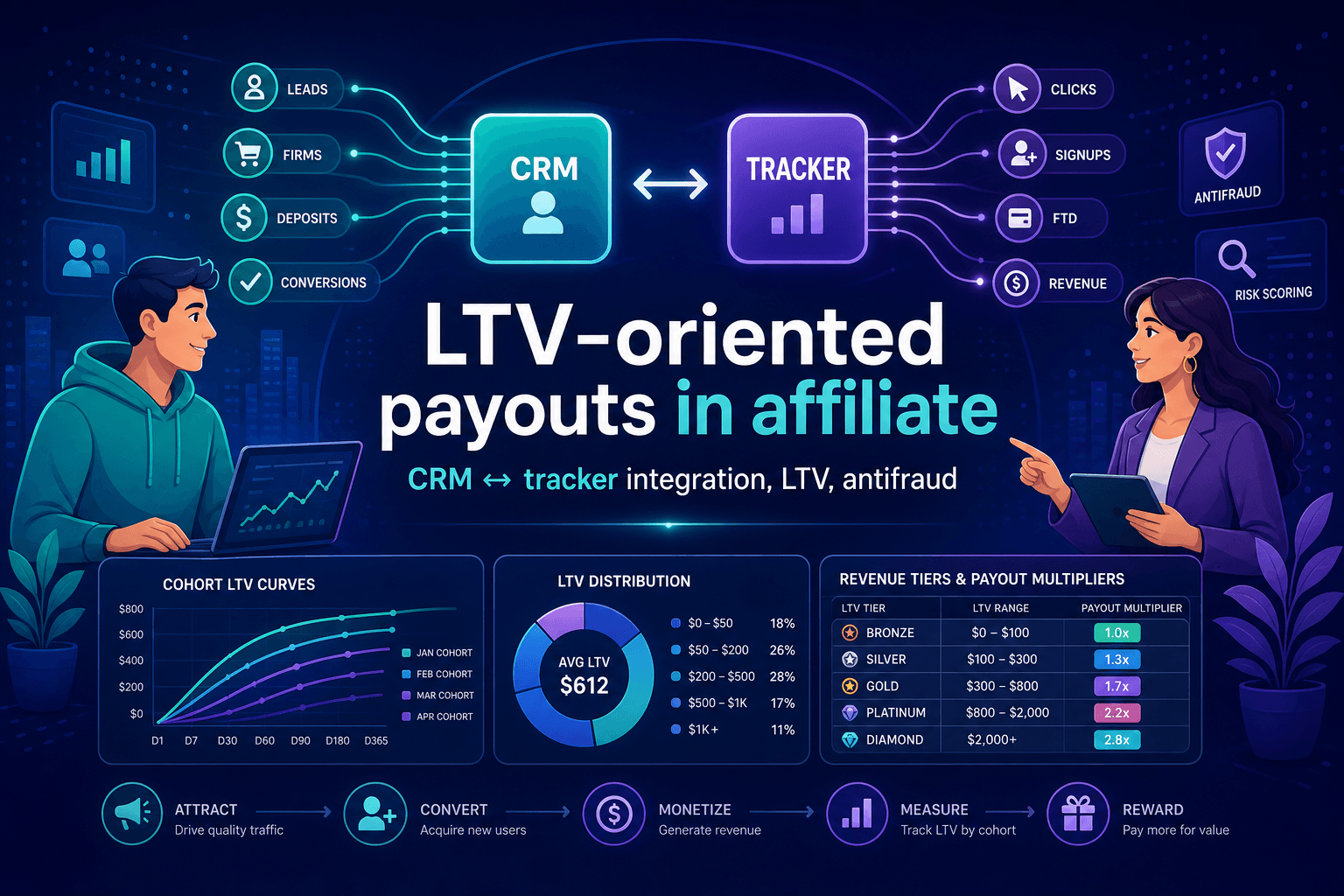
Most programs pay for a top‑funnel event (registration/deposit/apply). The issue is long‑term customer value (LTV) variance: two identical “leads” can yield opposite margins. The fix is to adopt LTV‑aware payouts and build a transparent data flow between your CRM and tracker.
What LTV means in affiliate
- LTV = total customer revenue over a period minus variable service costs.
- Measured by cohorts (first conversion date) and splits: publisher, source, campaign, creative.
- Used in payouts as: revenue share, CPA + “kicker” once an LTV threshold is hit, or deferred/staged payments.
Data you need
Required identifiers and events:
- click_id / transaction_id from the tracker (must reach the CRM on the user’s first action)
- external_id (lead_id / user_id in CRM)
- monetization events: purchase/deposit/renewal/upsell/refund/cancel
- attributes: currency, amount, source/campaign/creative markers, timestamp
- quality statuses: validated, fraud, duplicate
Privacy:
- don’t store PII in the tracker; use technical identifiers
- sign a DPA and define SLAs for deletion/anon
CRM ↔ tracker integration patterns
- S2S (postback) from CRM to tracker for every monetization event.
- Webhook → receiver → normalization → tracker (if tracker can’t ingest directly).
- ETL (daily dump) into DWH + BI reports; send only aggregates into tracker for payouts.
Example S2S postback from CRM to tracker:
POST https://tracker.example.com/postback?
click_id={click_id}&
event=purchase&
amount={amount}¤cy={currency}&
revenue={net_revenue}&
external_id={crm_user_id}&
ts={event_timestamp}Identifier mapping:
- pass click_id into CRM via UTM/query param or a hidden form field
- keep a lookup table external_id ↔ click_id for repeat purchases
LTV‑based payout models
- RevShare: 20–40% of net revenue during N days/months of the customer’s life
- CPA + LTV‑kicker: base CPA for the first event + bonus for hitting LTV X within 30/60 days
- Tiered grid: 0–X — 0%; X–Y — 20%; >Y — 35%
- Hold and validation: 7–30 days for refunds/cancellations
Quality and antifraud rules:
- attribution window: click → 30 days; view‑through banned/limited
- mandatory fields: user_agent, ip_hash, country; reject anomalies
- click‑spam/bots: filter by CTR, time‑to‑signup, conversions‑without‑visits, device entropy
- handle refunds/chargebacks: send negative events to the tracker (refund/cancel)
Control metrics
- LTV 7/30/60/90 by cohorts
- Payback (days) and pLTV (predicted LTV) via survival/retention models
- ROAS/ROMI by publishers and sources
- Refund/Chargeback rate, Valid lead rate
Cohort LTV aggregation (simplified):
SELECT publisher, cohort_date, SUM(net_revenue) / COUNT(DISTINCT user_id) AS LTV
FROM revenue_events
GROUP BY publisher, cohort_date
Implementation plan (30–60–90)
- 0–30 days: lock ID schema, add click_id to CRM, enable postbacks for purchase/refund, build a basic LTV‑30 report.
- 31–60 days: pilot with 3–5 publishers on RevShare/CPA+kicker; enforce antifraud rules, hold, validation.
- 61–90 days: scale, introduce tiered grid, automate payouts, enable pLTV‑driven bid optimization.
Risks and mitigations
- Missing CRM events → queues/retries, dead‑letter handling
- Currencies/taxes → store net revenue, unify FX rates daily
- Lost identifiers → dual storage (CRM + DWH), cross‑checks
Launch checklist
- [ ] click_id flows end‑to‑end to CRM and back via postbacks
- [ ] refund/cancel events + hold are implemented
- [ ] agreed net revenue formula and FX handling
- [ ] LTV 7/30/60/90 reports by publisher/source/creative
- [ ] signed quality rules and antifraud policies
Conclusion
LTV‑oriented payouts align advertiser and publisher incentives and protect margin. Start with a clean CRM ↔ tracker integration and clear rules. Next, automate payouts and optimize using pLTV.